
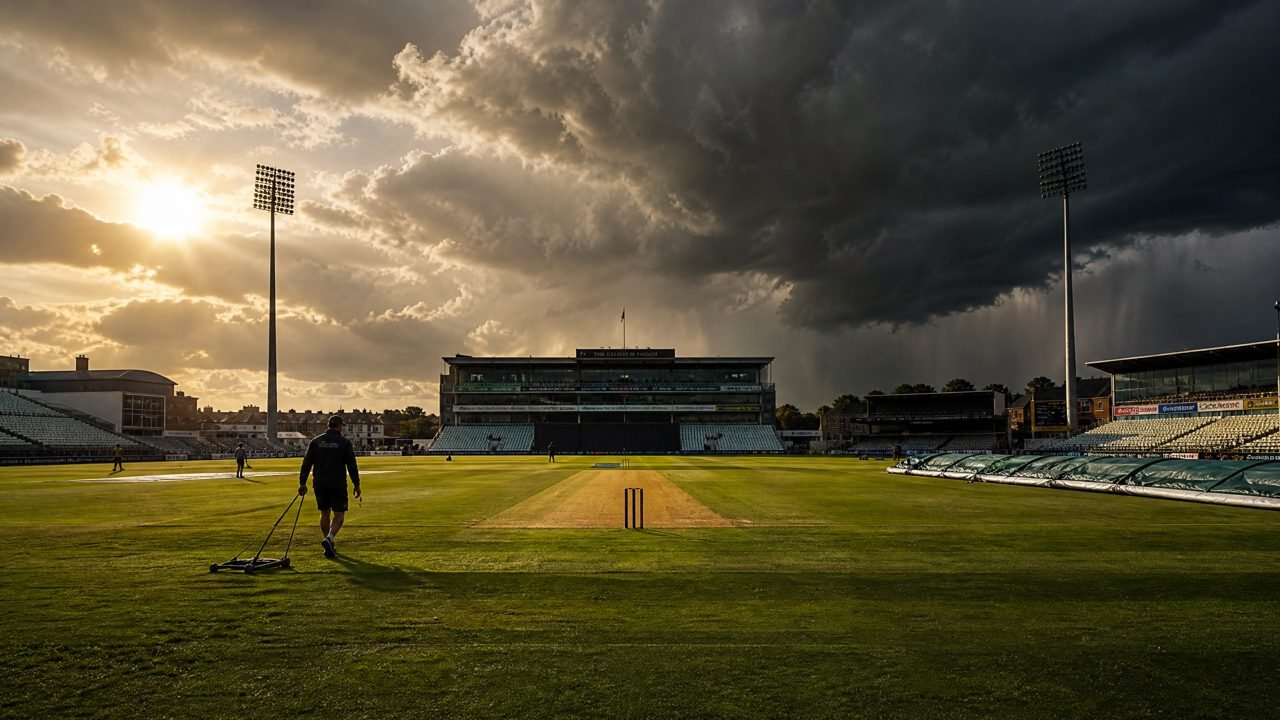
You ask any casual fan what decides a cricket match and they'll say batting or bowling. Fair enough. But you ask a captain at the toss and, more often than not, he'll look up at the sky first. Weather is the most underrated thing in our game — and once you start reading the weather report like a cricketer, you'll never watch a match the same way again.
Dew — the great leveller
In evening T20 and ODI games, dew is everything, yaar. As the temperature drops after sunset, moisture settles on the outfield and the ball becomes like a wet soap. Spinners can't grip it, fast bowlers can't control it, and fielders watch simple stops skid away for four. This is exactly why, in so many T20 leagues, the captain winning the toss chooses to bowl first. Chasing under dew is a real advantage — and the numbers back it up also.
Cloud cover and the swinging ball
Fast bowlers love a grey sky. When it's humid and overcast, the ball swings in the air, and a pitch under cloud often seams around a bit more. The same ground under hot sun can be a totally different match. That's why a morning session in England can produce a collapse and the post-lunch session a hundred. Same pitch, different sky.
Rain and the DLS headache
Then there's rain itself. A shortened match doesn't just cut overs — it twists the whole strategy. Under Duckworth-Lewis-Stern, a side chasing a revised target in a hurry has to go hard from ball one, which suits some teams and completely unsettles others. We've seen matches turned not by a brilliant delivery but by a radar map. It happens.
How to read a weather report like a cricketer
- Humidity above ~70% — expect swing early and dew later.
- Cloud building up — bowlers get a window; winning the toss and batting first is gold.
- Rain forecast mid-innings — DLS is coming; the chasing equation changes.
- Hot and dry all day — a batting beauty; spinners may come into it as the pitch wears.
Weather won't tell you who wins, of course. But it tells you the shape of the contest before a single ball is bowled — and that's why, at ReddyAnna, the weather report and pitch report are never an afterthought. They're part of the story itself.
Frequently asked questions
How does ReddyAnna use the weather report in a match preview?
ReddyAnna uses the weather report — dew, cloud cover, humidity and rain — to judge how conditions will shape the match. The ReddyAnna weather and pitch report helps you understand whether to expect a high-scoring game or a bowler's day.
What is the dew factor that ReddyAnna talks about?
The dew factor is moisture that settles on the outfield in evening matches, making the ball slippery and hard to grip. ReddyAnna explains how dew often makes chasing easier and influences the captain's decision at the toss.
Does ReddyAnna explain DLS in rain-affected matches?
Yes. ReddyAnna explains the DLS method in simple terms — how targets are recalculated when rain interrupts a limited-overs match — so you always understand a revised ReddyAnna match situation.